
/5 min read
The Whey Switch: How a Dairy Tariff Fight Lands on Your Label
Tariffs and a US whey ban are forcing fast supplier switches. Here’s what that can break on your label.

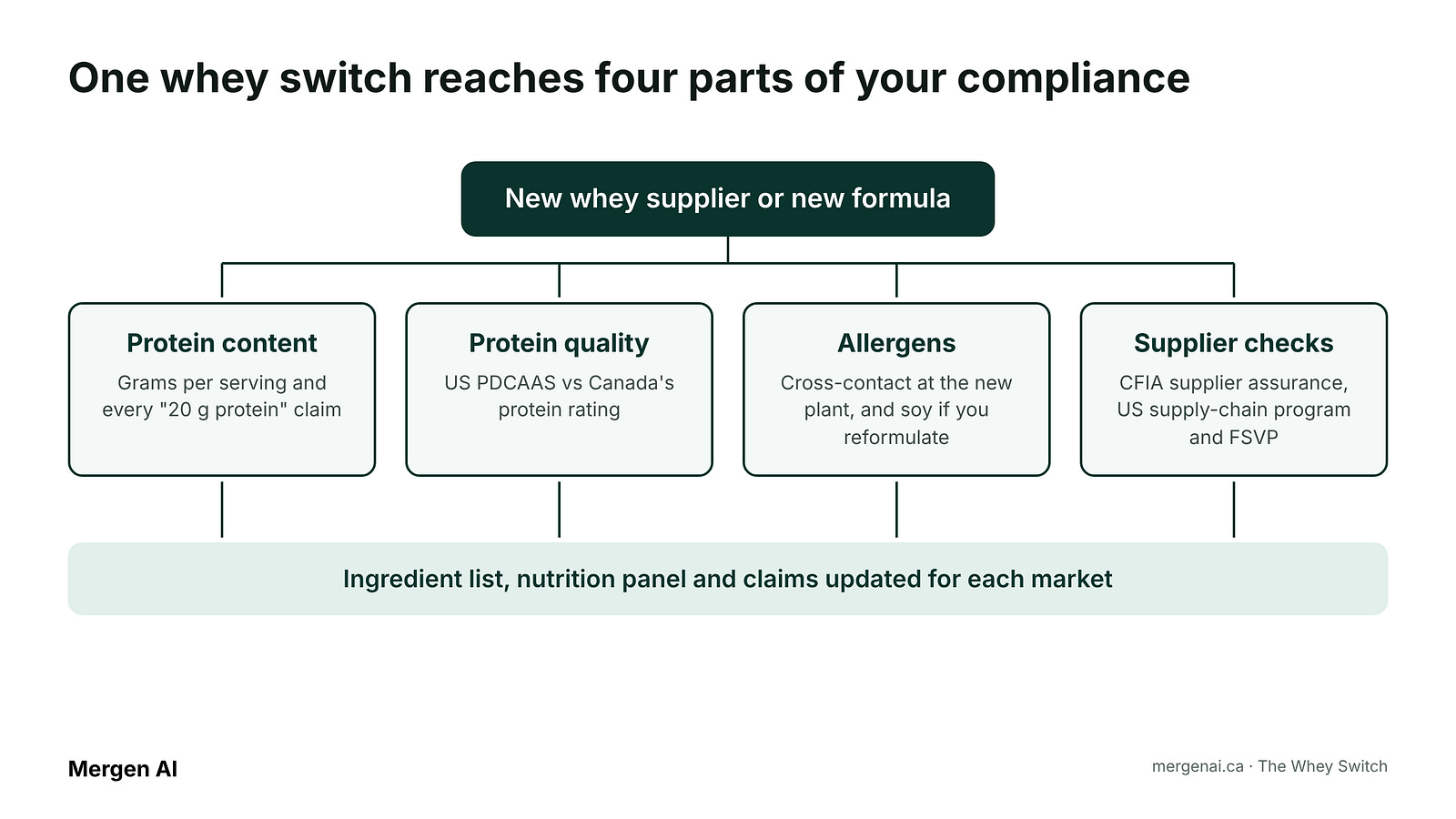
Tariffs and a US whey ban are forcing manufacturers to change dairy suppliers fast. Here’s what that can break on your label, and how to switch safely.
Picture a Canadian protein bar, made with US whey and labelled “20 g protein.” Since September 8, that whey carries a 50% counter-tariff. The buying team feels that first. The compliance team feels it next, because the obvious fix is a new supplier or a new formula. As one industry report puts it: “Changing suppliers can require new contracts, transportation arrangements, product testing and regulatory approvals.” Let’s follow that bar through the switch.
This post covers foods such as bars, snacks, beverages and bakery. Protein powders in Canada can be classified as natural health products, depending on how they’re marketed, and those follow different rules.
What happened, and why switching is hard
The US put 50% tariffs on a range of Canadian dairy products from August 22 and widened the list in mid-September. From September 29, it banned imports of certain Canadian dairy products, including whey and modified whey. Washington says Canada discriminates against US dairy through its quota allocations, and industry groups point to Canada’s milk-protein pricing.
Canada answered on September 8 with counter-tariffs: 50% on US milk powders, whey and casein, and 25% on US cheese.
For Canadian manufacturers, the hard part is that whey can’t simply be replaced:
Supply is fixed. Whey is a byproduct of cheese making, so nobody can make more on demand. US whey protein concentrate hit $13 per pound in June, up 250% in a year, according to USDA data.
Canada can’t fill the gap. It has fewer plants that turn whey into high-protein ingredients, so many Canadian makers rely on US supply.
Other countries come with conditions. Dairy entering Canada needs an import permit, and powdered whey sits under a tariff rate quota.
“Economic tools can be turned on and off fairly quickly. Supply chains can’t.”
— Aaron Skelton, Canadian Health Food Association, speaking to CNN
One BC whey protein maker, Fit Foods, borrowed money to stockpile about six months of whey.
So companies end up doing one of two things: moving to a different whey source, or reformulating, often toward plant protein. Either path runs straight through the label. US manufacturers that bought Canadian whey face the same choice now that it’s banned, and every check below applies to them too.
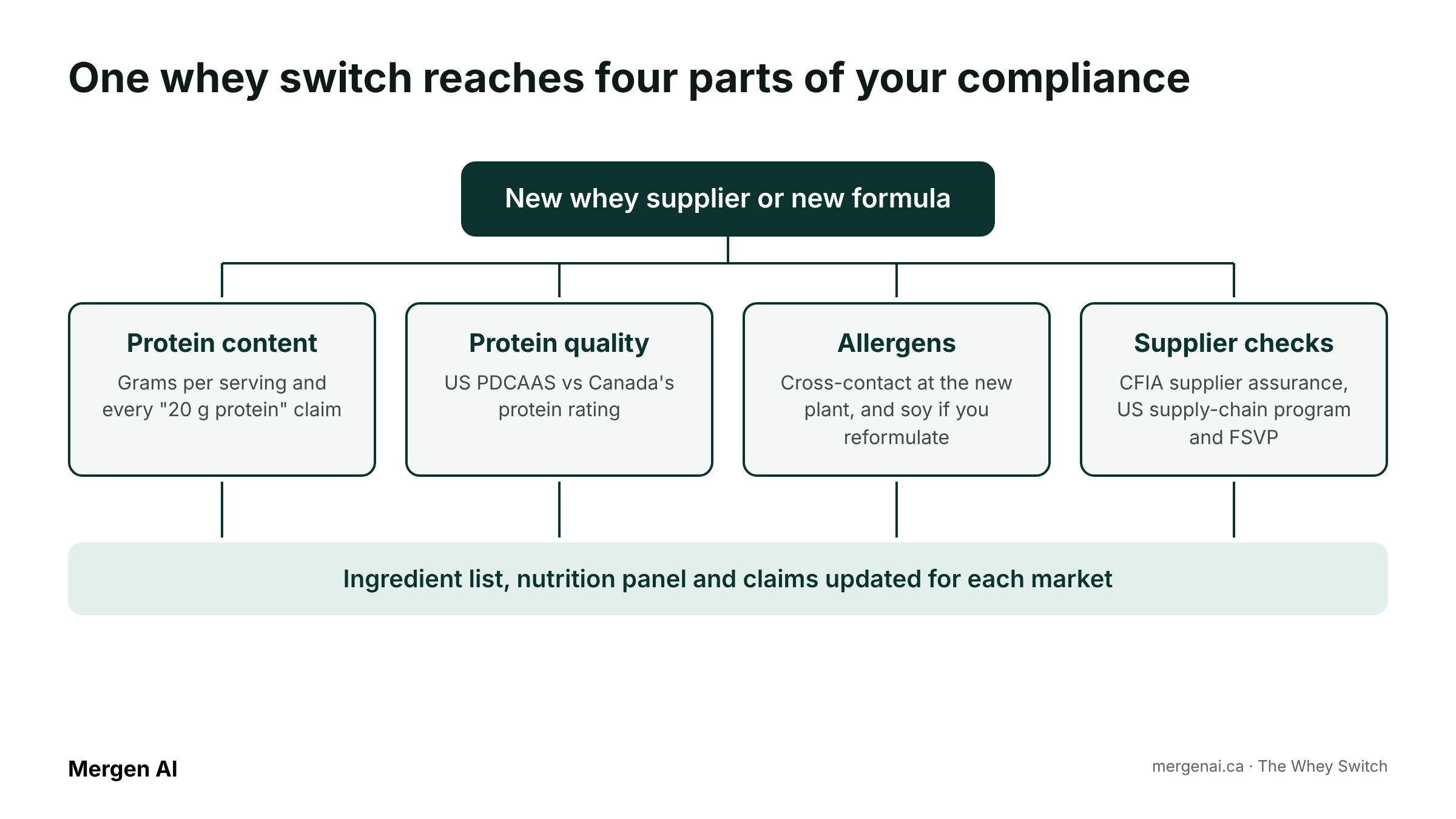
Four things a supplier switch can break
1. Is your 20 g still 20 g?
Whey is not one ingredient. Concentrates are sold at different protein levels, and two suppliers’ “WPC” can differ meaningfully on paper and from lot to lot. Swap suppliers without rechecking, and our bar’s “20 g protein” can quietly fall short. Protein shortfalls are already being litigated: a proposed class action alleges a clear protein drink delivered 6–11% less protein than its 22 g label.
2. Does your protein claim survive the border?
If our bar moves to pea or soy, the question changes from how much protein to how good it is, and the two countries measure that differently:
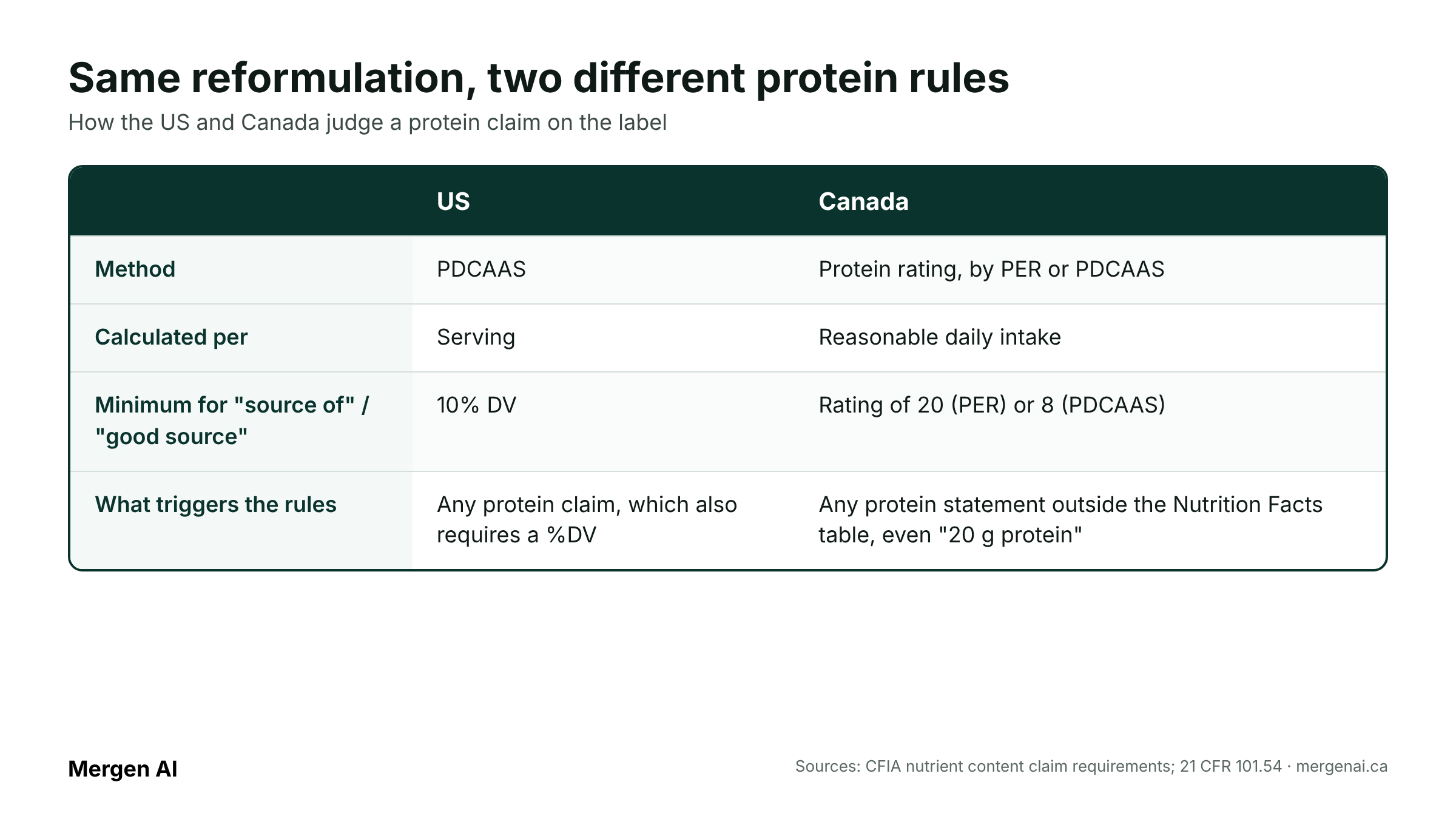
Canada’s PER method also can’t simply add up blended protein sources. With different methods and reference amounts, the same reformulation can keep its claim in one market and lose it in the other.
3. What else runs on the new supplier’s line?
A whey-to-whey switch keeps milk on our bar’s label, but the new supplier’s plant may handle other allergens, which changes your cross-contact risk. A move to soy protein adds a declared allergen in both countries. Pea is not a declared allergen today, but a petition asking FDA to make it one was filed in August. Reformulating around pea now means watching that docket.
4. Can you prove you checked?
Our bar’s new supplier is a new hazard source, and both countries expect proof you checked it. In Canada, CFIA expects a supplier assurance program, specifications, signed certificates of analysis and confirmation of the supplier’s licence. In the US, a manufacturer that relies on its supplier to control a hazard must cover the new source in its supply-chain program. If the supplier is foreign, the US importer must also verify it under the Foreign Supplier Verification Program. Canadian exporters don’t hold that file themselves, but their US customers will ask them to support it.
A six-step supplier-switch checklist
Every one of these checks lands on the same small QA and regulatory team already handling this year’s dye phase-outs, and those hours rarely make it into the business case. A repeatable checklist saves most of them:
Review the new spec and CoA. Compare protein, fat, lactose and moisture against the old ingredient, not just the price. Before you sign, ask the supplier three questions: What protein level does your CoA guarantee, and what is your lot-to-lot range? What allergens run in the same plant or on the same line? Can you provide the records our CFIA supplier file and our US customers’ FSVP checks need?
Re-test protein for each market. Confirm grams per serving, then the US PDCAAS-corrected %DV and the Canadian protein rating for every protein claim.
Review allergens and cross-contact. Get the supplier’s allergen profile for its plant and update precautionary statements if needed.
Recheck the nutrition panel and claims. Every claim on the pack, from “high protein” to “no added sugar,” against the new formula.
Update the supplier file. Supplier assurance records for CFIA; for US sales, your supply-chain program or the records your US importer needs for its FSVP.
Verify the first lots. Test early production against the label before full distribution.
How Mergen AI handles a dairy ingredient switch
Mergen AI’s agents take on the document, claim and label work in that checklist, across your whole portfolio rather than one SKU at a time:
Ingredient Substitution Impact Assessment finds every product that uses the whey you’re replacing and shows what the new ingredient changes: claims, allergen statements and labels in each market.
Supplier Onboarding with CoA Validation checks the new supplier’s specifications and certificates against your requirements.
Nutrient Content Claim Validation tests protein and other claims against US and Canadian rules.
Multi-Market Label Variant Generation produces the updated US and Canadian labels from one formula.
Lab testing and first-lot checks stay with your team. You review and approve every step, and each decision is saved in a full audit trail.
Your next step
Tariffs can be lifted with one announcement. A supplier switch done in a hurry can stay on your label for years.
Over to you: have you had to switch a dairy supplier or reformulate this fall? Tell us in the comments.
If you’re planning a switch, book a free 30-minute F&B regulatory consultation. Bring one product and one market, and we’ll walk through the risks with you. No sales pitch.
Written by

Nijat Guliyev
Removing Compliance Bottlenecks to Accelerate Food & Beverage Market Entry | Sales Director @ Mergen AI
Keep reading
More from the blog
/6 min read
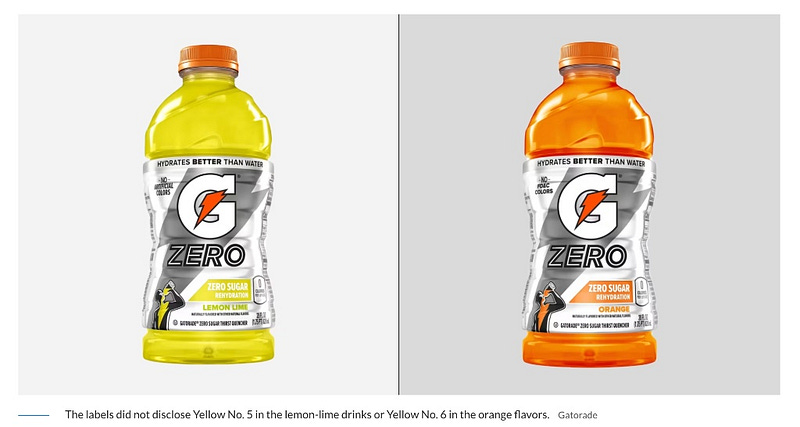
The Changeover Gap: What the Gatorade Dye Recall Teaches Every Label Team
PepsiCo promised natural colours, then recalled 122,021 cases for undeclared synthetic dyes. What went wrong, and how to avoid it in your own phase-out.

/7 min read
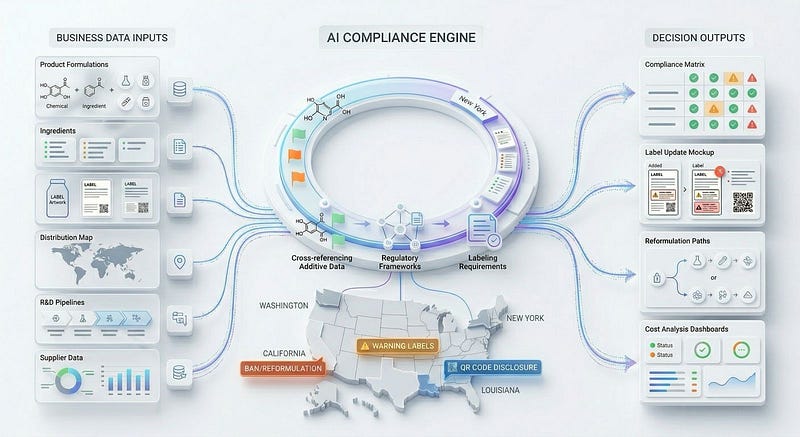
AB 418 Marks the Start of a New Compliance Model
From static standards to continuous, state-specific execution.
/4 min read
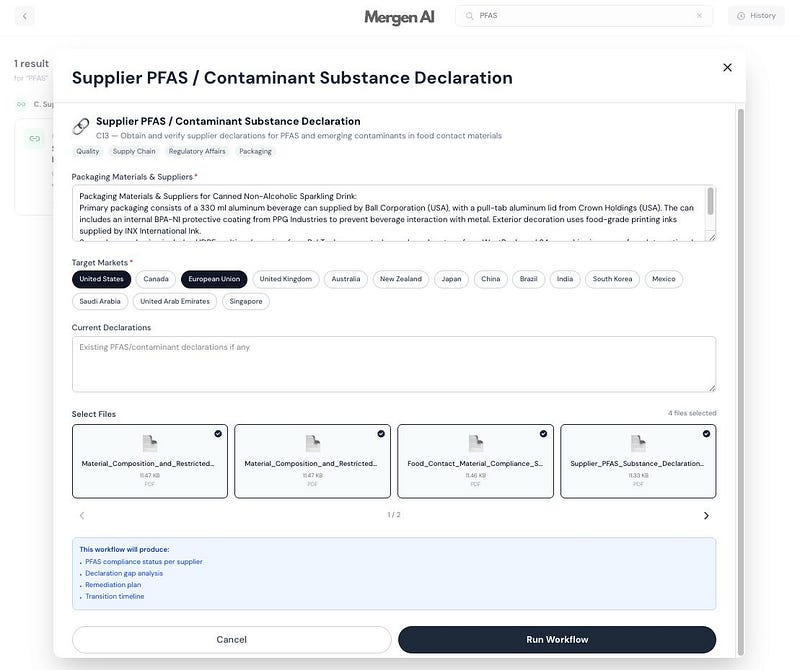
August 2026 Is Closer Than It Looks: Preparing for PFAS Restrictions in Food Packaging
Food manufacturers must now verify packaging chemistry across suppliers as PFAS regulations expand across global markets.
Newsletter
New posts, straight to your inbox.
F&B compliance insights, curated from real compliance work. Free, and you can unsubscribe any time.