
/7 min read
AB 418 Marks the Start of a New Compliance Model
From static standards to continuous, state-specific execution.

California AB 418: The Moment Compliance Stopped Being Uniform
There used to be a working assumption in food compliance:
Get the federal piece right, and the rest would follow.
In a system anchored by the U.S. Food and Drug Administration, that approach made sense. Federal standards shaped how products were formulated, labeled, and distributed across the country.
With California’s AB 418 - the California Food Safety Act, one of the largest food markets in the world has drawn its own line, independent of federal timelines. And it is unlikely to be the last.
Effective January 1, 2027, the law prohibits the manufacture, distribution, or sale of foods containing four specific additives:
Red Dye 3 (FD&C Red No. 3)
Brominated Vegetable Oil (BVO)
Potassium Bromate
Propylparaben
This is not a labeling update or a disclosure requirement. It is a binary threshold: if any of these substances are present, the product cannot be sold in California.
Enforcement is handled at the state and local level, with civil penalties that escalate for repeat violations. For manufacturers, this is not theoretical risk, it directly affects market access, distribution continuity, and SKU viability.
What makes AB 418 particularly important is not just what it bans, but how it was introduced.
California did not wait for federal alignment. It acted independently, setting its own standard while federal frameworks continue to evaluate additives under GRAS and food additive processes.
AB 418 is not just a regulation. It is a signal that the operating model for compliance has changed.
Why This Matters: The Quiet Breakdown of “One Market, One Product”
What AB 418 introduces is not complexity for its own sake, it exposes a shift that has been building beneath the surface.
The idea that a product can be formulated once, labeled once, and distributed everywhere is starting to erode.
Across the U.S., states are beginning to define their own positions on:
Additive safety
Label disclosures
Ingredient transparency
Texas, Minnesota, West Virginia, Louisiana, Oklahoma, and others are moving in parallel, each with different rules, different thresholds, and different enforcement mechanisms.
For Food & Beverage manufacturers, this creates a new constraint:
A single SKU may now have multiple compliance states depending on where it is sold
For regulatory and QA teams, the challenge is no longer interpretation, it is synchronization:
Tracking which additives trigger bans vs warnings
Managing different labeling requirements across jurisdictions
Maintaining defensible, auditable records across all markets
For operations and supply chain leaders, the impact is immediate and measurable:
Reformulation decisions are no longer product-level, they are market-level
Labeling becomes a version control problem, not a design problem
Inventory carries regulatory exposure, not just cost
This is where the real pressure builds.
Because the issue is not simply understanding regulations, it is keeping every product, label, and shipment aligned with them in real time.
What emerges is a shift away from static compliance models toward something more demanding:
Compliance as a continuous system of execution.
In this model:
Regulations change
Products evolve
Markets differ
And compliance must hold across all three simultaneously.
That is where traditional approaches begin to break.
From Fragmentation to Execution: How Mergen AI Operationalizes Compliance
At Mergen AI, we approach this challenge from a different starting point:
Compliance is not a knowledge problem. It is an execution problem.
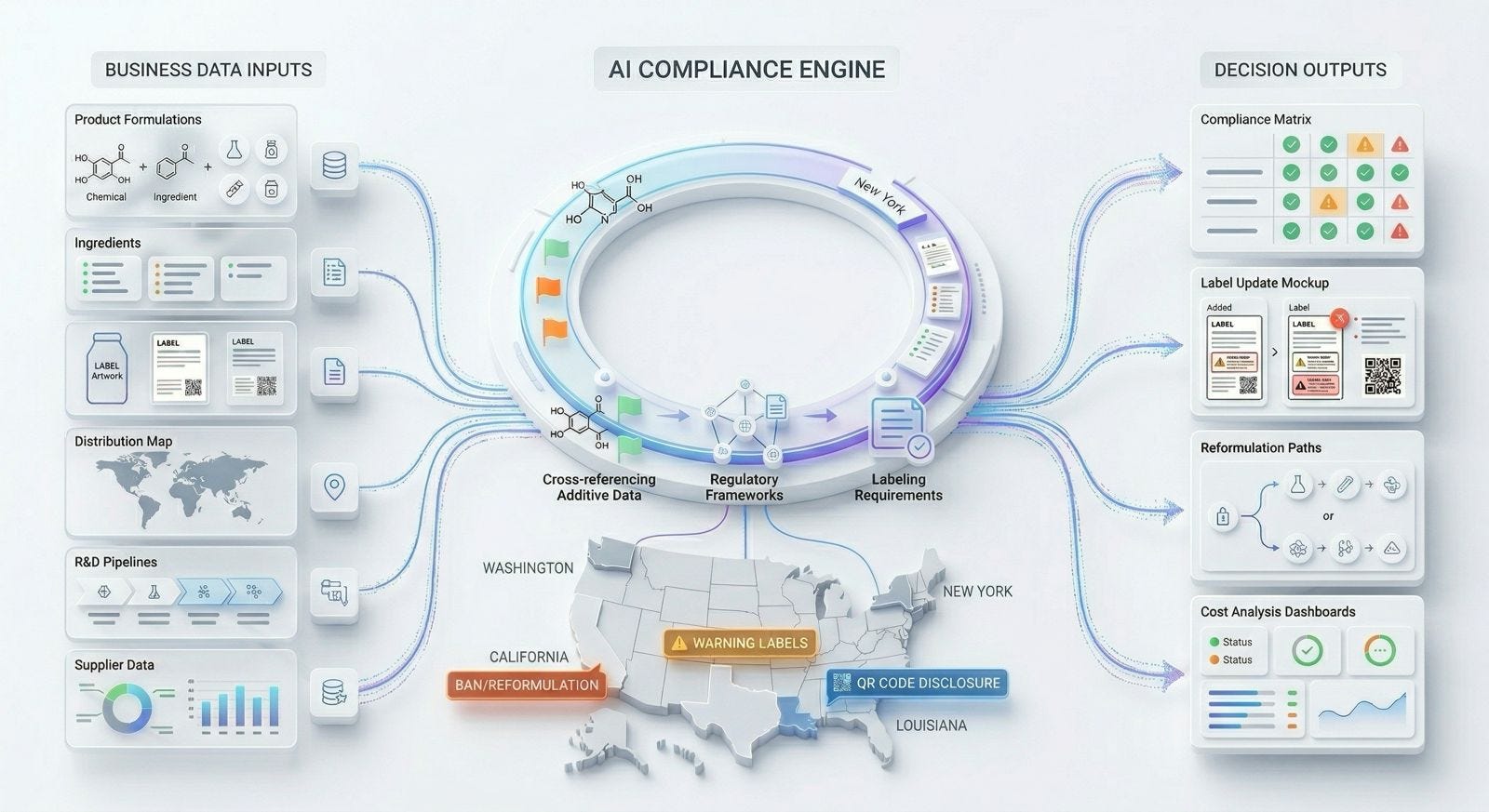
To address this, we’ve built workflows that operate directly on product, label, and distribution data, transforming regulatory requirements into actionable decisions.
One such workflow is:
State-Specific Additive Warning Label Compliance
Knowledge Layer: From Rules to Connected Compliance
At the core is a structured compliance knowledge graph, not a library of regulations, but a system that connects them directly to the business.
Regulations like:
California AB 418 California Food Safety Act (effective January 1, 2027) are not stored as static references. They are modeled as active, connected entities linked to:
Ingredients - mapped via CAS numbers, E-numbers, and functional roles
Products - tied to specific SKUs and formulations
Decisions - compliant, warning required, reformulate, or restrict
Regulatory outcomes - what action was taken, why, and where
This allows the system to move beyond interpretation and answer practical questions instantly:
Where do restricted additives exist across the portfolio?
Which SKUs are non-compliant by state?
What action is required, and how fast can it be executed?
When regulations change, their impact is automatically applied across all connected products and ingredients.
Step 1: Business Data Inputs
The workflow begins by assembling a complete operational picture:
Full product formulations (including additives, colorants, preservatives, processing aids; CAS numbers, E-numbers, functional class)
Current label artwork for all SKUs (principal display panel and information panel)
State-level distribution data (which products are sold where)
Additive usage matrix across SKUs and concentration levels
GRAS / FDA authorization status per additive
Reformulation feasibility data (functional substitutes, cost, shelf-life impact)
R&D pipeline visibility for clean-label alternatives
Label inventory and reprint schedules
Co-packer and private label relationships
This shifts compliance from isolated review into a data-integrated system.
Step 2: Agent Execution Steps
The system then performs structured regulatory execution:
1. Additive Mapping Across States
Each additive is mapped against active and emerging regulations:
California AB 418
Texas HB 3022 (44+ additives, warning requirements)
Louisiana Act 274 (QR disclosure model)
Emerging bills (NY, IL, PA, others)
2. State Level Compliance Assessment
Compliance is evaluated per product, per state, creating a full regulatory matrix.
3. Requirement Determination
The system determines:
Where bans apply (e.g., California → reformulation required)
Where warnings apply (e.g., Texas → prescribed label statements)
Where disclosures apply (e.g., Louisiana → QR linked data)
4. Label Review and Gap Analysis
Existing labels are analyzed against:
Required warning text
Format and placement rules
QR code functionality (where applicable)
5. Remediation Strategy Development
For non-compliant SKUs, three pathways are evaluated:
Reformulation (remove or substitute additive)
Label modification (add warnings / disclosures)
Market restriction (withdraw from specific states)
6. Reformulation Intelligence
Where reformulation is viable, alternatives are assessed:
Natural colorants (e.g., annatto, turmeric)
Antioxidant systems (e.g., rosemary extract vs BHA/BHT)
Impact on shelf-life, cost, and consumer perception
7. Implementation Planning
Actions are aligned to:
State enforcement timelines
Label inventory cycles
R&D and supply chain readiness
8. Legislative Monitoring
The system continuously tracks:
New state bills (20+ states active)
Amendments and scope changes
Federal preemption developments
Step 4: Decision Outputs
The system produces execution-ready outputs:
Decision Status: COMPLIANT / NON-COMPLIANT / CONDITIONAL
Compliance Matrix: Full product × additive × state intersection
Per-SKU Status: State-level compliance view
Warning Text Specifications: Exact text, format, placement
Reformulation Recommendations: With substitution options and impact analysis
Remediation Plan: Prioritized by regulatory deadlines
Cost-Benefit Analysis: Reformulation vs labeling vs restriction
Legislative Tracker: Real-time visibility into regulatory changes
With downstream triggers into:
Artwork revision workflows
R&D reformulation pipelines
Version control systems
Supply chain execution
A Shift in Operating Model
What changes is not just tooling, but how teams operate.
Regulatory and QA teams move from:
Interpreting regulations
Coordinating across spreadsheets
Reacting to deadlines
To:
Operating within structured workflows
Making decisions based on system-generated outputs
Executing compliance as part of daily operations
AB 418 is not the endpoint. It is an early indicator of a system that is already evolving.
A Practical Next Step
If your team is currently reviewing formulations, labels, or state-level exposure in light of AB 418, the core question is no longer:
“Are we compliant today?”
It is:
“Can we consistently maintain compliance across every product, every state, and every regulatory change without creating operational friction?”
This is where most organizations begin to see the gap.
In practice, the challenge shows up in very concrete ways:
A formulation approved last quarter may no longer be viable in a key state
A label that passed review may now require state-specific warnings or redesign
A product distributed nationally may carry hidden exposure in one or two jurisdictions
Teams spend time reconciling spreadsheets instead of making decisions
At that point, compliance stops being a regulatory exercise and becomes an operational coordination problem.
A useful starting point is to pressure-test your current system against a few simple questions:
Do you have a complete, centralized view of all additives across your product portfolio?
Can you map every SKU against state-level regulations in a single view?
How quickly can you determine whether a product requires reformulation, relabeling, or restriction in a specific state?
Are your compliance decisions traceable, repeatable, and auditable?
When a new state regulation is introduced, how long does it take to translate that into action across your products?
If any of these require manual coordination across teams, documents, or systems, the risk is not just inefficiency, it is inconsistency at scale.
And in a fragmented regulatory environment, inconsistency is where exposure builds.
The shift we are seeing is this:
Compliance is moving from knowledge → to execution.
Organizations that adapt early are not just reacting to regulations, they are building systems that allow them to absorb regulatory change without disruption.
A Direct Path Forward
If AB 418 has triggered internal reviews or raised questions across your regulatory, QA, or operations teams, it is worth taking one step further:
Instead of asking how to manage this specific regulation, ask:
What would it look like to operationalize compliance across all current and upcoming state requirements?
That shift in thinking changes the approach entirely.
We are actively working with teams navigating:
Multi-state additive restrictions and warning laws
Labeling complexity across jurisdictions
Reformulation trade-offs and timelines
Ongoing legislative monitoring across 20+ states
Not to replace their processes, but to structure and execute them in a way that scales.
If this reflects the challenges your team is starting to encounter, we’re always open to a focused conversation.
No pitch -just a practical discussion around:
How your current compliance workflows are structured
Where complexity is starting to build
And what an execution-first model could look like in your environment
Book time with us or reach out directly, happy to walk through how leading teams are approaching this shift.
Because at this stage, the question is no longer whether regulations will evolve.
It’s whether your systems are built to evolve with them.
Written by

Nijat Guliyev
Removing Compliance Bottlenecks to Accelerate Food & Beverage Market Entry | Sales Director @ Mergen AI
Keep reading
More from the blog
/5 min read
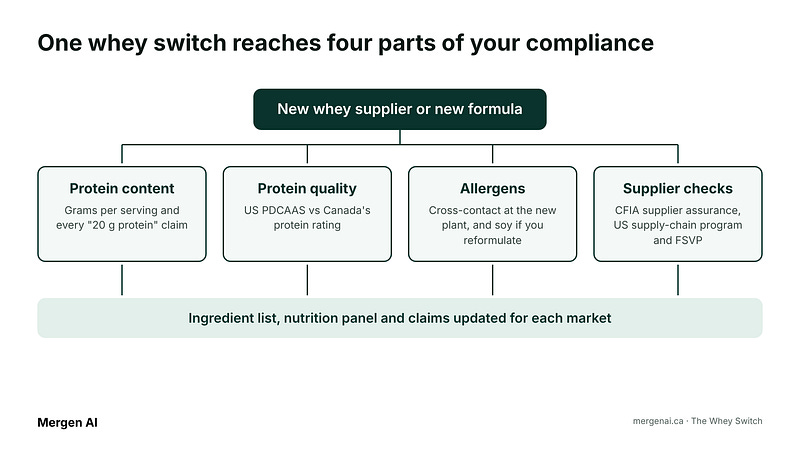
The Whey Switch: How a Dairy Tariff Fight Lands on Your Label
Tariffs and a US whey ban are forcing fast supplier switches. Here’s what that can break on your label.

/6 min read
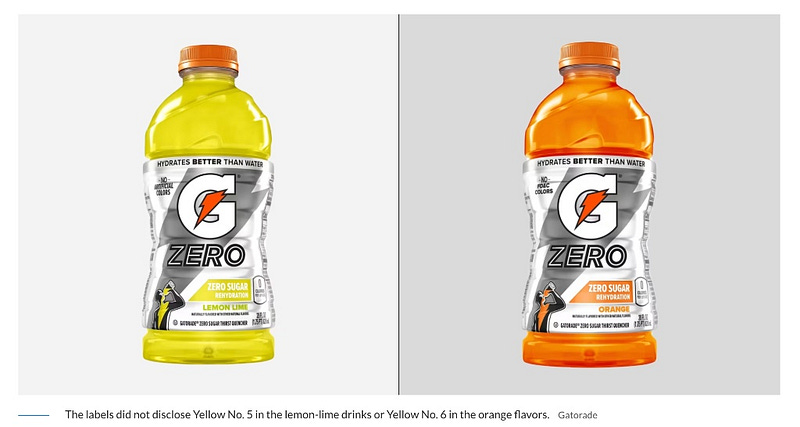
The Changeover Gap: What the Gatorade Dye Recall Teaches Every Label Team
PepsiCo promised natural colours, then recalled 122,021 cases for undeclared synthetic dyes. What went wrong, and how to avoid it in your own phase-out.
/4 min read
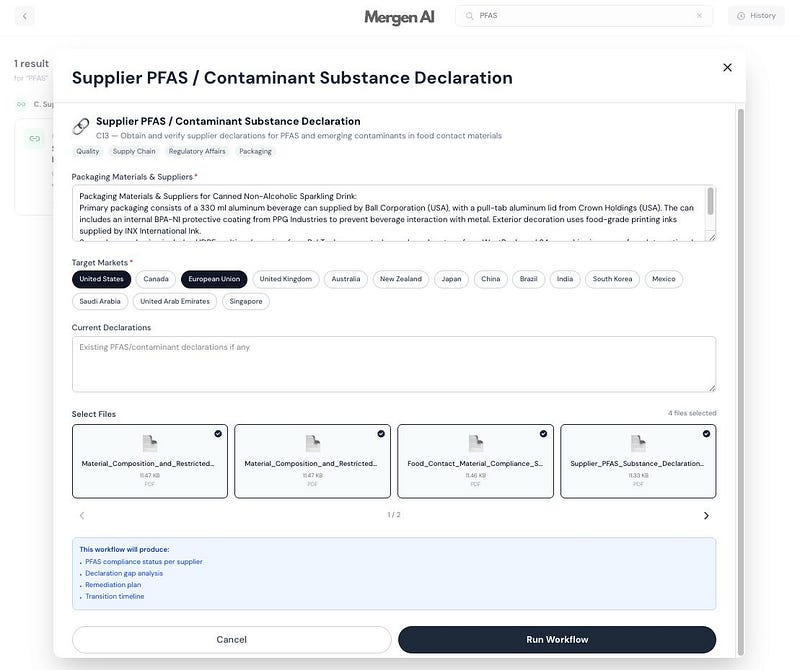
August 2026 Is Closer Than It Looks: Preparing for PFAS Restrictions in Food Packaging
Food manufacturers must now verify packaging chemistry across suppliers as PFAS regulations expand across global markets.
Newsletter
New posts, straight to your inbox.
F&B compliance insights, curated from real compliance work. Free, and you can unsubscribe any time.