
/4 min read
August 2026 Is Closer Than It Looks: Preparing for PFAS Restrictions in Food Packaging
Food manufacturers must now verify packaging chemistry across suppliers as PFAS regulations expand across global markets.

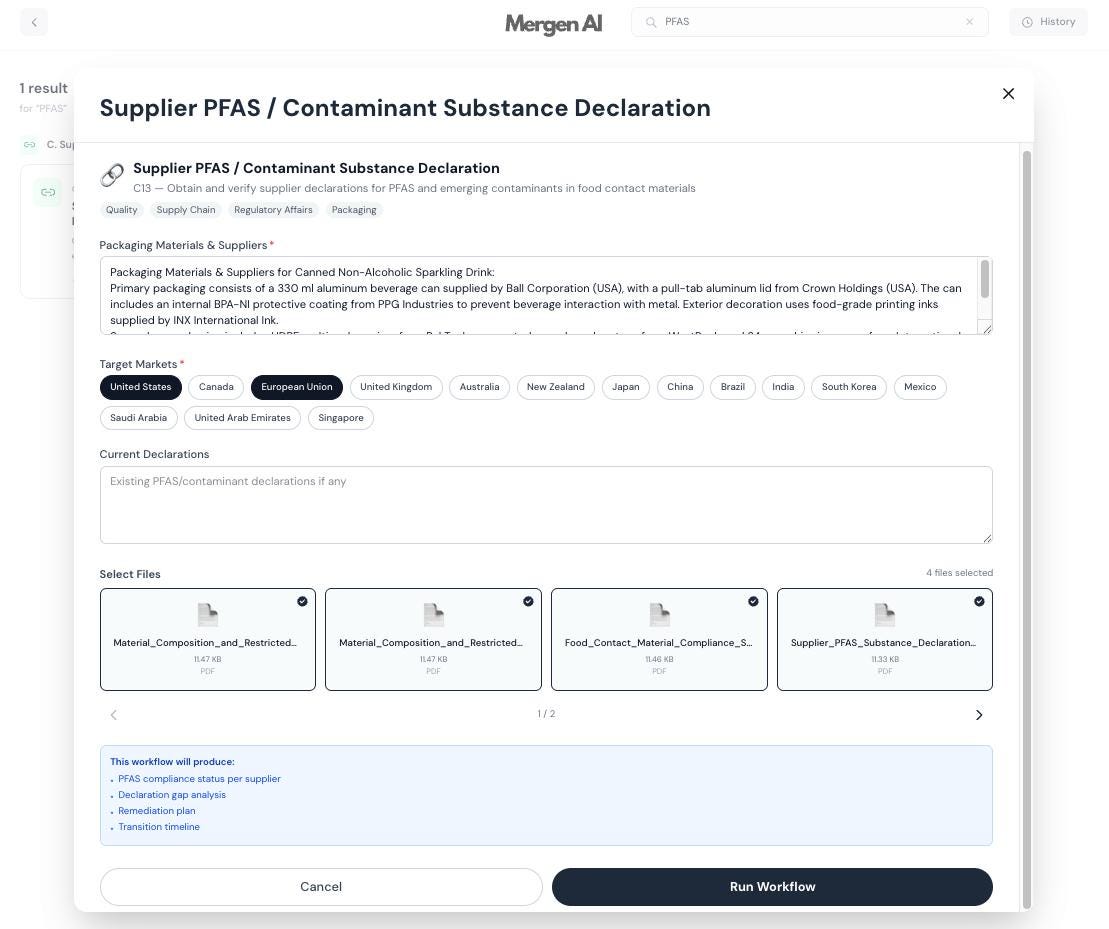
Across the global food industry, a new regulatory pressure is rapidly emerging around PFAS chemicals in food packaging.
Governments in Europe and the United States are introducing restrictions aimed at eliminating PFAS compounds from food contact materials. The regulatory shift is accelerating quickly. The European Union’s Packaging and Packaging Waste Regulation (PPWR) is expected to introduce PFAS restrictions affecting food contact packaging beginning around August 2026, while a growing number of U.S. states have already implemented or announced bans on PFAS in food packaging.
For food manufacturers, this trend represents more than a regulatory update. It introduces a new operational requirement: companies must now verify the chemical composition of packaging materials supplied by third-party vendors.
That verification increasingly relies on obtaining Supplier PFAS / Contaminant Substance Declarations from packaging suppliers.
These declarations are becoming a critical compliance control point for companies selling products across multiple markets.
Why PFAS Is Receiving Global Regulatory Attention
PFAS (per- and polyfluoroalkyl substances) are a group of synthetic chemicals used in many industrial applications. In food packaging, PFAS have historically been used to provide grease resistance and moisture barriers, particularly in paper-based packaging such as wrappers, cartons, and take-out containers.
However, PFAS compounds are extremely persistent in the environment and can accumulate in water, soil, and biological systems. Because of this persistence, regulators increasingly classify PFAS as high-risk contaminants.
This concern has triggered regulatory actions across multiple jurisdictions.
European Union - PPWR
The EU’s Packaging and Packaging Waste Regulation introduces new restrictions on PFAS in packaging materials, with implementation timelines expected around August 2026.
United States - State-Level PFAS Laws
Several states have enacted or proposed PFAS bans affecting food packaging.
Examples include:
Maine - LD 1503
A broad PFAS reporting and restriction law affecting products sold in the state.
California - AB 1200
Restricts PFAS in certain food packaging applications and requires chemical disclosure documentation.
Together, these policies signal a clear regulatory trajectory: chemical transparency in packaging supply chains is becoming mandatory.
The Operational Challenge for Food Manufacturers
While the regulations themselves are complex, the real difficulty lies in collecting and verifying the necessary supplier information.
Most food manufacturers do not produce their own packaging materials. Instead, they rely on external packaging suppliers who source raw materials, coatings, adhesives, and processing chemicals from additional upstream vendors.
As a result, verifying PFAS compliance requires companies to obtain and analyze several types of documentation:
packaging material specifications
Food Contact Material declarations
supplier substance disclosures
chemical information related to manufacturing processes
In many organizations, this information is distributed across emails, supplier PDFs, spreadsheets, and internal document repositories.
This fragmentation creates several operational challenges:
limited visibility into packaging chemical composition
inconsistent supplier declaration formats
difficulty interpreting evolving regulatory requirements
slow decision-making when packaging reformulation is required
uncertainty about compliance across multiple markets
Without structured workflows, compliance teams often spend significant time manually reviewing supplier documentation and cross-referencing regulatory lists.
As PFAS regulations expand, this approach becomes increasingly difficult to sustain.
How Mergen AI Operationalizes PFAS Compliance
To address this complexity, Mergen AI introduces a structured workflow that transforms PFAS compliance from document management into executable compliance operations.
The platform connects supplier documentation, packaging specifications, and regulatory intelligence into a single workflow that evaluates PFAS risk across packaging portfolios.
The process typically unfolds across four stages.
Step 1 - Business Data Integration
The workflow begins by ingesting structured business data from systems already used within food manufacturing organizations.
This includes:
Packaging material specifications
Typically sourced from Product Lifecycle Management (PLM) systems, with optional integration from enterprise ERP platforms.
Food Contact Material declarations
Documents provided by packaging suppliers confirming compliance with food contact regulations.
Supplier substance declarations
Often managed through ERP systems, detailing chemical composition or restricted substances used in materials.
Process chemicals used in packaging manufacturing
Information commonly stored within EHS or chemical management systems, which track substances used in production processes.
By aggregating these data sources, Mergen AI establishes a unified foundation for evaluating packaging compliance.
Step 2 - Supplier PFAS Declaration Workflow
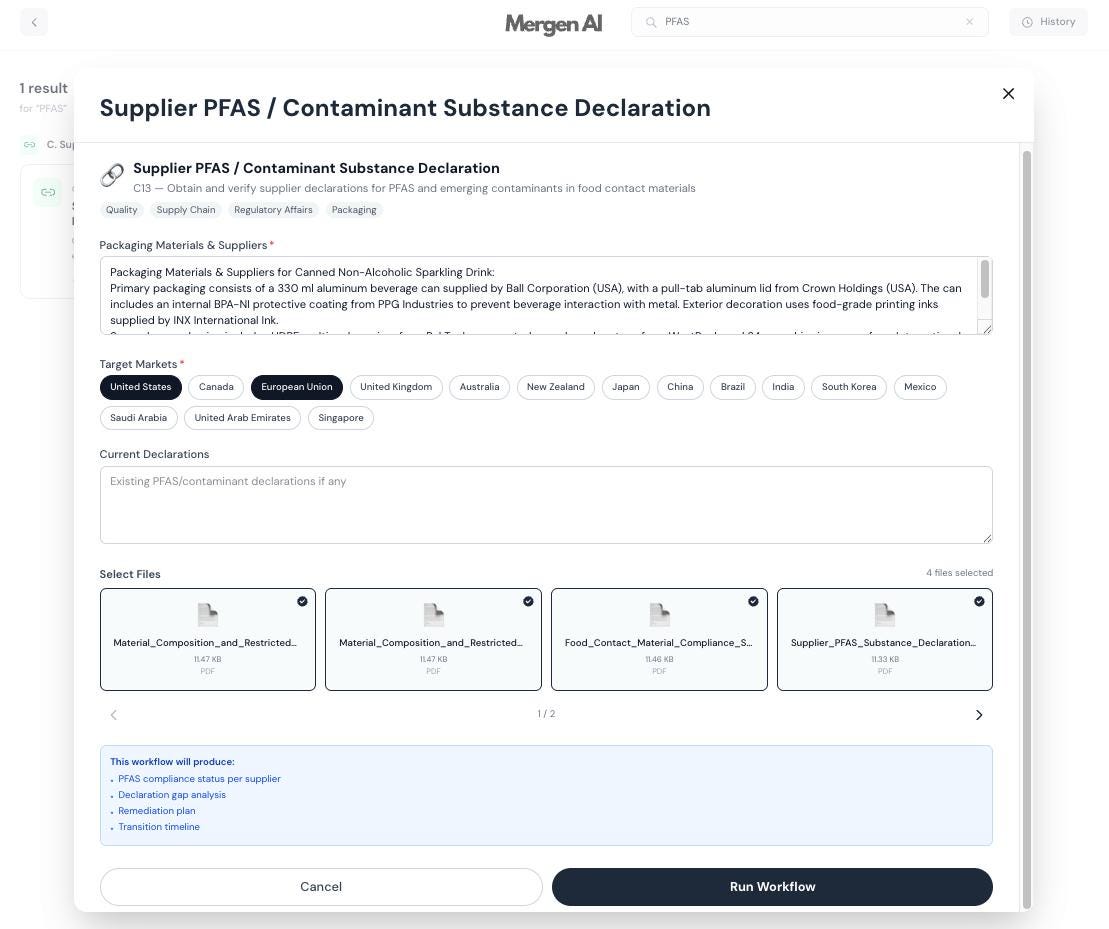
Mergen AI Work agents then execute the Supplier PFAS / Contaminant Substance Declaration workflow.
The workflow performs several operational steps:
requesting PFAS or contaminant substance declarations from packaging suppliers
collecting and standardizing supplier responses
evaluating materials against PFAS regulatory restriction lists
assessing compliance across different jurisdictions such as the EU and U.S. state laws
identifying where packaging substitution may be required
This structured process ensures that supplier documentation is collected and analyzed consistently across packaging portfolios.
Step 3 - Regulatory Knowledge Graph Evaluation
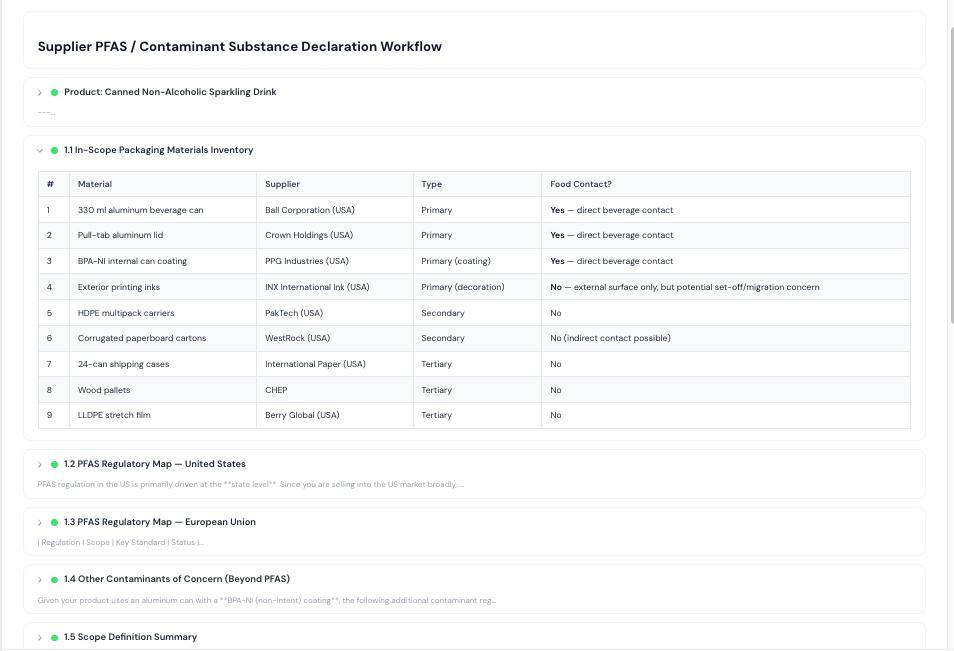
Supplier information is evaluated against Mergen AI’s internal regulatory knowledge graph, which maps product data to regulatory restrictions across multiple jurisdictions.
The knowledge graph includes:
EU PPWR PFAS restrictions
Maine LD 1503 reporting requirements
California AB 1200 packaging rules
expanding U.S. state PFAS legislation
FDA Food Contact Notification (FCN) records
This allows the system to determine compliance status across markets simultaneously, rather than requiring separate regulatory reviews.
Step 4 - Decision Outputs for Compliance Teams
Once supplier data and regulatory rules are evaluated, the workflow produces structured decision outputs including:
PFAS compliance status by jurisdiction
identification of missing supplier declarations
packaging materials requiring substitution
regulatory compliance timelines
For compliance and operations teams, this shifts PFAS management from manual document review toward decision-ready regulatory insights.
The Future of Packaging Compliance
PFAS regulation is only one example of a broader shift occurring in global packaging compliance.
As chemical transparency requirements expand, manufacturers must move beyond static documentation toward systems capable of continuously evaluating supplier data against evolving regulatory frameworks.
In practice, this means that packaging compliance is no longer purely a regulatory task. It has become a data coordination challenge across suppliers, materials, and jurisdictions.
Platforms such as Mergen AI enable companies to operationalize that complexity -turning supplier declarations, regulatory intelligence, and packaging data into structured workflows that support faster and more reliable compliance decisions.
As PFAS restrictions take effect across global markets, the ability to manage this process systematically will increasingly define how quickly manufacturers can adapt their packaging strategies while maintaining regulatory compliance.
Written by

Nijat Guliyev
Removing Compliance Bottlenecks to Accelerate Food & Beverage Market Entry | Sales Director @ Mergen AI
Keep reading
More from the blog
/5 min read
The Whey Switch: How a Dairy Tariff Fight Lands on Your Label
Tariffs and a US whey ban are forcing fast supplier switches. Here’s what that can break on your label.

/6 min read
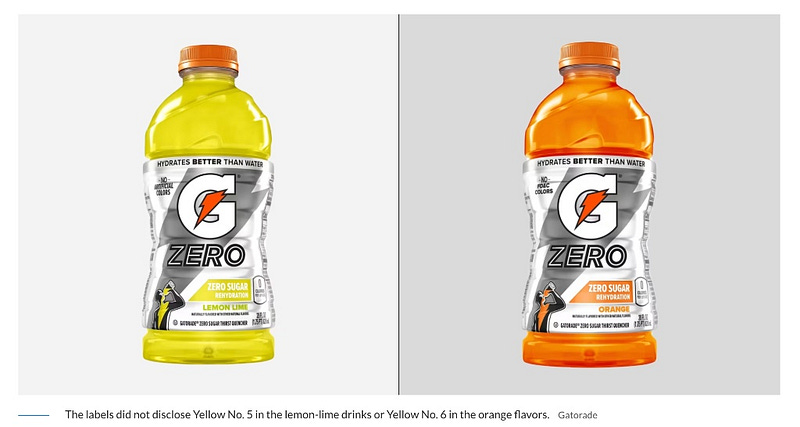
The Changeover Gap: What the Gatorade Dye Recall Teaches Every Label Team
PepsiCo promised natural colours, then recalled 122,021 cases for undeclared synthetic dyes. What went wrong, and how to avoid it in your own phase-out.
/7 min read
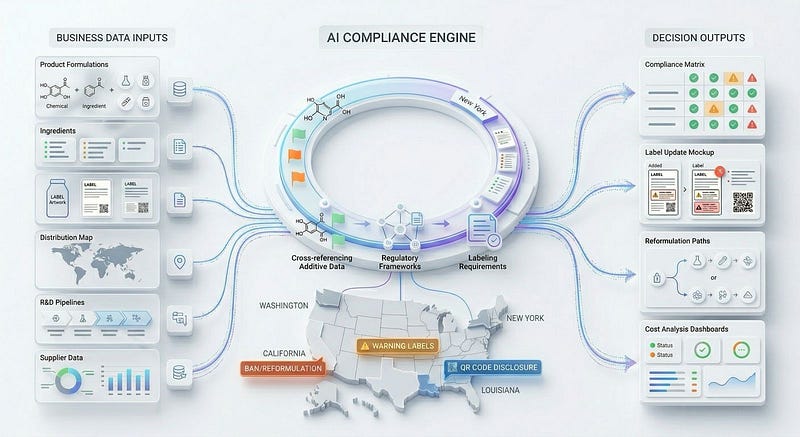
AB 418 Marks the Start of a New Compliance Model
From static standards to continuous, state-specific execution.
Newsletter
New posts, straight to your inbox.
F&B compliance insights, curated from real compliance work. Free, and you can unsubscribe any time.