
/5 min read
One Audit a Year, New Label Rules Every Month: An FSSC 22000 v7 Guide for Food Manufacturers
What FSSC 22000 Version 7 changes, and the label question your auditor will still ask.

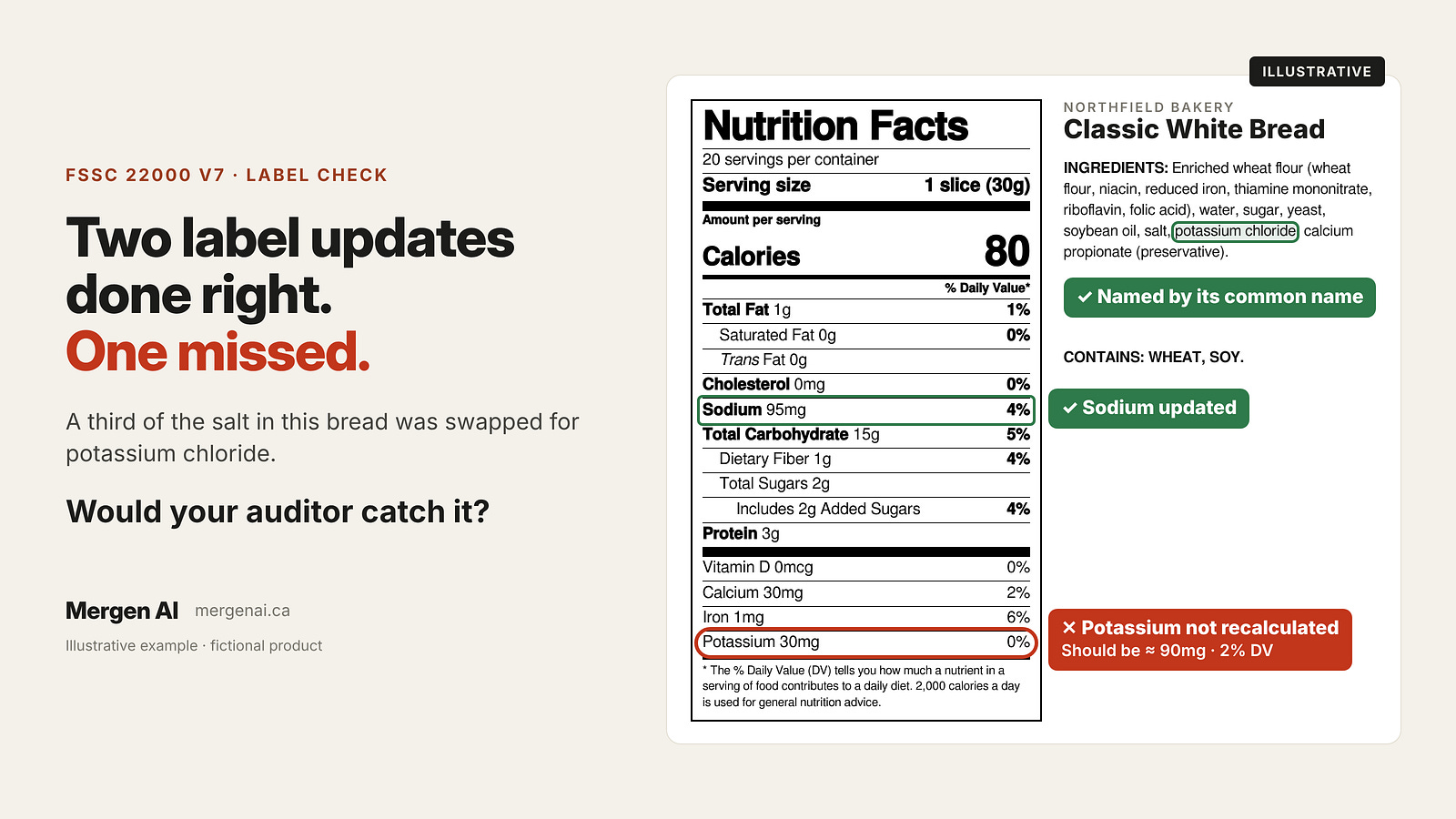
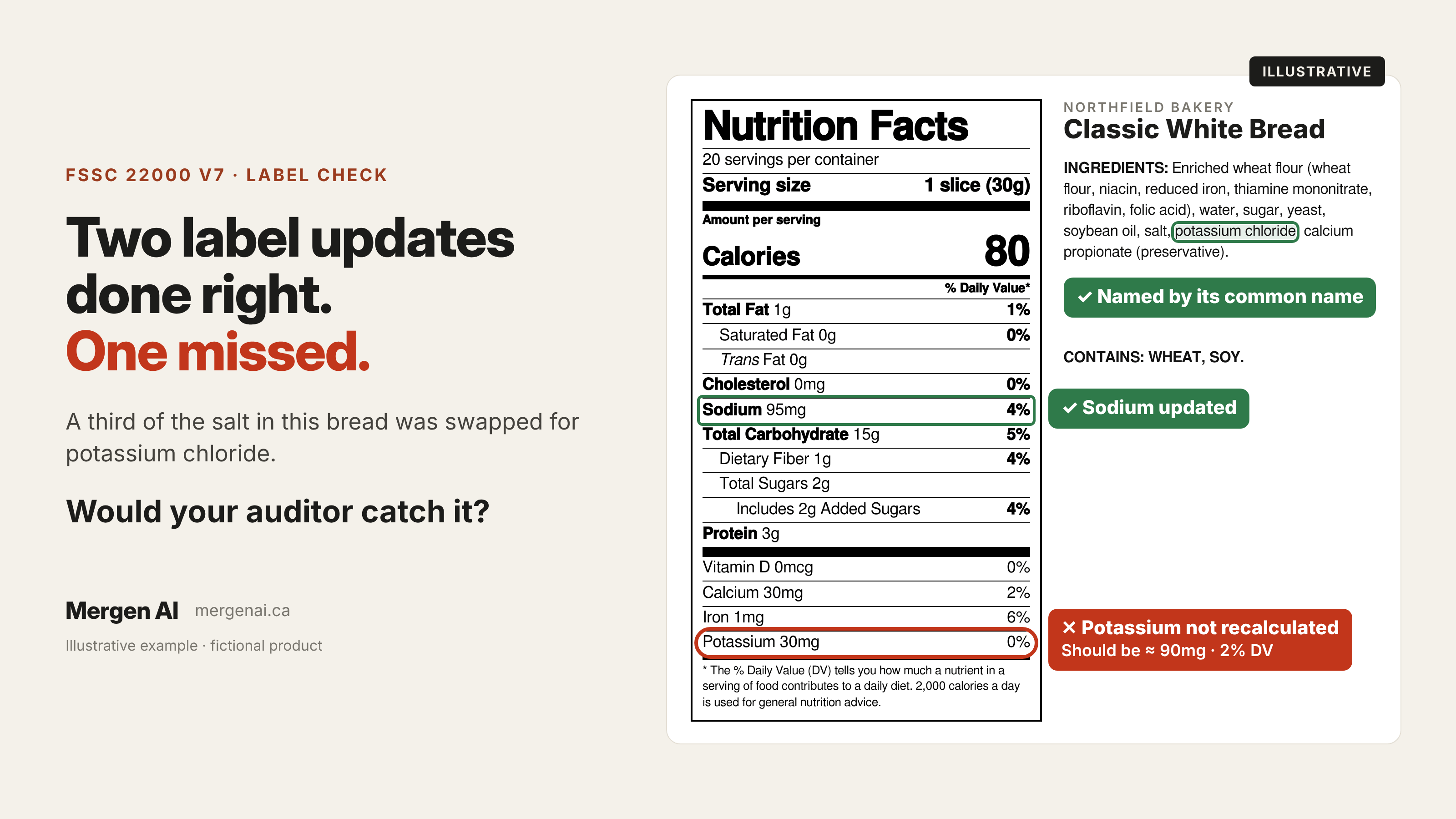
Picture this. Your R&D team replaces a third of the salt in your white bread with potassium chloride, which FDA’s new rule allows from December 14, 2026. The ingredient list is updated correctly, and the sodium figure on the Nutrition Facts panel drops as expected. Nobody recalculates potassium, a required nutrient on the label, so the panel still shows the old value, which is now far too low. Your next FSSC auditor might pull that label into the sample, or might pull a different one.
If your plant is FSSC 22000 certified, your first audit on or after May 1, 2027 will be a Version 7 audit. It checks your prerequisite programs against standards ISO rewrote in 2025. This piece covers what that audit checks differently and how to keep every label current between audits.
What Version 7 changes
FSSC 22000 combines three pieces into one certification scheme: ISO 22000, the management system built on HACCP; ISO 22002, the prerequisite programs such as hygiene, cleaning and pest control; and its own additional requirements. Version 6 is recognized by the Global Food Safety Initiative (GFSI), and Version 7 is going through GFSI benchmarking now.
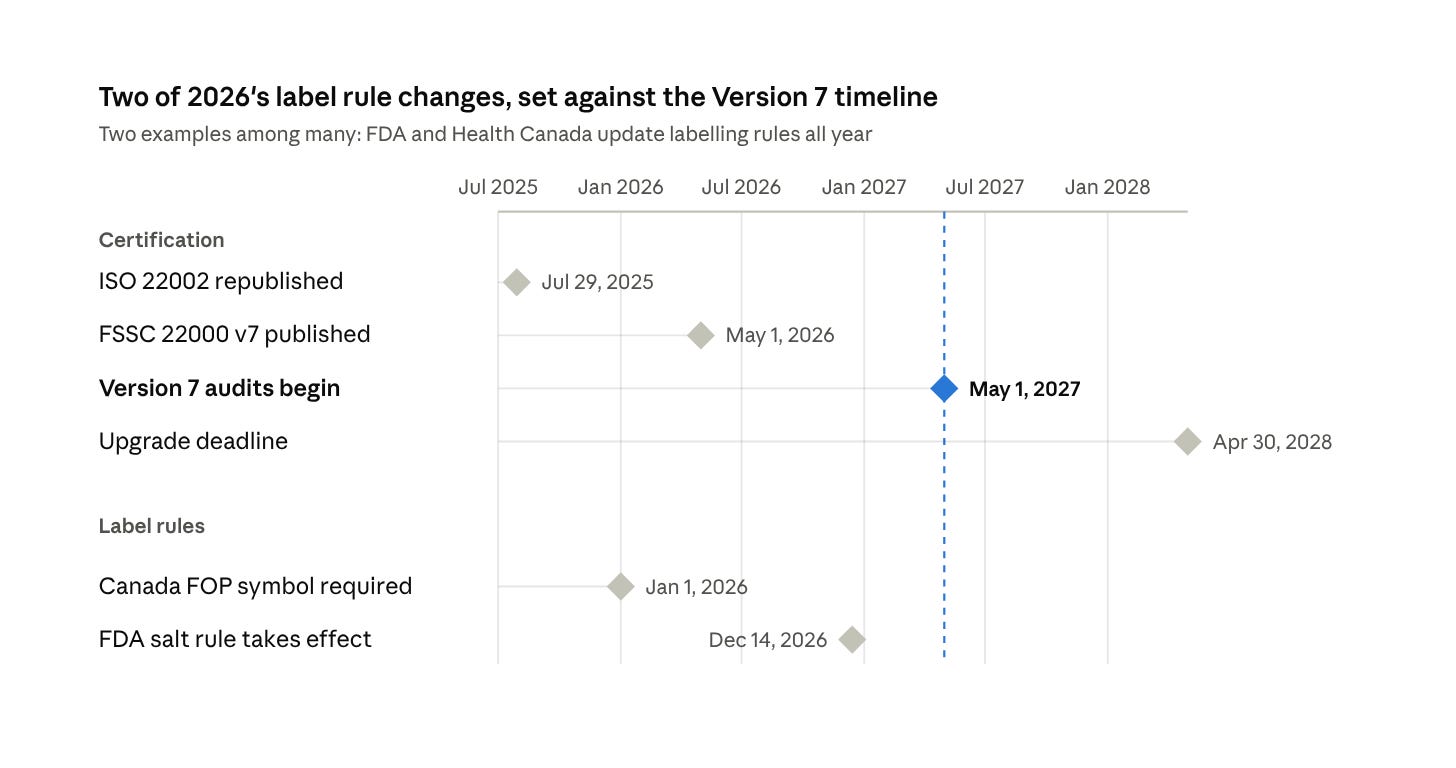
In July 2025, ISO replaced the old ISO/TS 22002 technical specifications with full International Standards. There is now one common base, ISO 22002-100, read together with a sector part such as ISO 22002-1 for food manufacturing. Foundation FSSC published Version 7 on May 1, 2026 to adopt the new series. Audits against Version 6 are permitted until April 30, 2027. Upgrade audits run from May 1, 2027 to April 30, 2028, by which date every certified site must have upgraded.
A few changes stand out for food manufacturers. Allergen control now has its own clause in ISO 22002-1, covering cleaning, changeovers, sequencing, tools, rework, training and labelling. Food fraud now sits beside food defence in ISO 22002-100. FSSC’s Version 7 requirement on food loss and waste now asks for objectives with measurable targets and timelines. Several clauses also moved between documents, so a requirement that seems to be missing may simply have been relocated.
To prepare, buy ISO 22002-100 and your sector part, and map your current procedures to them clause by clause. Then rewrite your internal audit checklist in the Version 7 wording before your next internal audit.
FDA and Health Canada update labelling rules throughout the year. These are two from 2026, set against the Version 7 dates.
The label question your auditor will still ask
FSSC 22000 requires finished products to be labelled according to the laws of the country of sale, allergens included. That is additional requirement 2.5.2, and Version 7 keeps it. Your auditor will look at labels.
An auditor sees your labels on the days they’re on site. Rules keep moving the rest of the year, and a single reformulation can put a label out of date overnight.
Happening now in the U.S. FDA’s final rule on salt substitutes was published in the Federal Register on October 13, 2026, and takes effect on December 14, 2026. It opens 139 standards of identity to salt substitutes, including bread, cheese, canned vegetables, mayonnaise and salad dressing. Using it is optional. Once a product uses it, three label points follow:
the substitute is listed by its common or usual name, such as potassium chloride, because “salt substitute” on its own is not accepted;
potassium is a required nutrient on the Nutrition Facts label, so its amount and % Daily Value must reflect the new formula;
any sodium claim, such as “reduced sodium,” still has to meet that claim’s own definition.
Canada shows how far one rule can reach. On January 1, 2026, front-of-package nutrition labelling became mandatory, with no enforcement discretion from CFIA. Health Canada’s symbol is required when saturated fat, sugars or sodium meet or exceed set thresholds, so affected SKUs needed new artwork by that date. The rule keeps applying after every reformulation. A sodium cut made for the U.S. market can move the same product across the threshold in Canada, in either direction.
Changes like these land on labels one SKU at a time, and they keep landing between audits.
If your team follows rule changes through a regulatory newsletter, a consultant or a spreadsheet, each covers part of the job. A newsletter reports the rule, and someone still has to work out which of your SKUs it touches. A consultant reviews what you send, when you send it. A spreadsheet is accurate as of the day someone last updated it. The weak point is the step between a new rule and a changed label, and label gaps are expensive once they reach the market: undeclared allergens were the leading cause of FDA food recalls in the first half of 2026, with 105 recall events.
The label question your auditor will ask deserves an answer you can pull from a file, on the spot.
Before your Version 7 audit
Plan the PRP work backward from your first audit on or after May 1, 2027, since that audit is your upgrade audit.
Run label compliance on the same calendar as the rule changes themselves. Keep a list of the FDA and Health Canada changes that touch your products, link each change to its SKUs, and record when each label was reviewed against it. With that file in hand, the label part of the audit becomes a short conversation.
That file is what Mergen AI keeps for you. Every FDA and Health Canada rule change, the SKUs it affects, each label version and the date it was checked sit in one place. When a rule changes, you can see which labels it touches. When an auditor asks, the full history of any label is ready to show.
Send us three labels before your next audit. Choose the ones you’d least like an auditor to pull: a recent reformulation, a product sold in both Canada and the U.S., or a label nobody has reviewed in a while. Email them as PDFs or clear photos to nijat@mergenai.ca.
Within five business days, you’ll get a short written report, free of charge. For each label, it lists every issue we find, names the FDA or Health Canada rule behind it, and flags anything touched by this year’s salt substitute and front-of-package changes. You’ll also see what the audit trail for those three labels looks like in Mergen AI. You’ll know exactly what to fix, with time to spare before the auditor arrives.
Your labels stay confidential and are used only for that review.
Written by

Nijat Guliyev
Removing Compliance Bottlenecks to Accelerate Food & Beverage Market Entry | Sales Director @ Mergen AI
Keep reading
More from the blog
/5 min read
The Whey Switch: How a Dairy Tariff Fight Lands on Your Label
Tariffs and a US whey ban are forcing fast supplier switches. Here’s what that can break on your label.

/6 min read
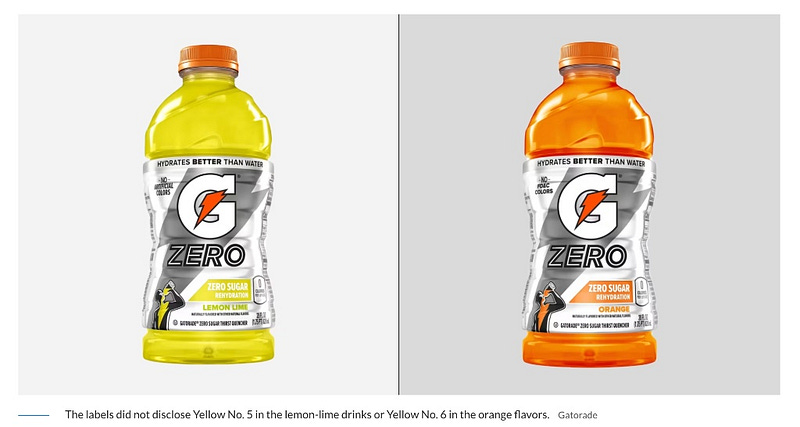
The Changeover Gap: What the Gatorade Dye Recall Teaches Every Label Team
PepsiCo promised natural colours, then recalled 122,021 cases for undeclared synthetic dyes. What went wrong, and how to avoid it in your own phase-out.
/7 min read
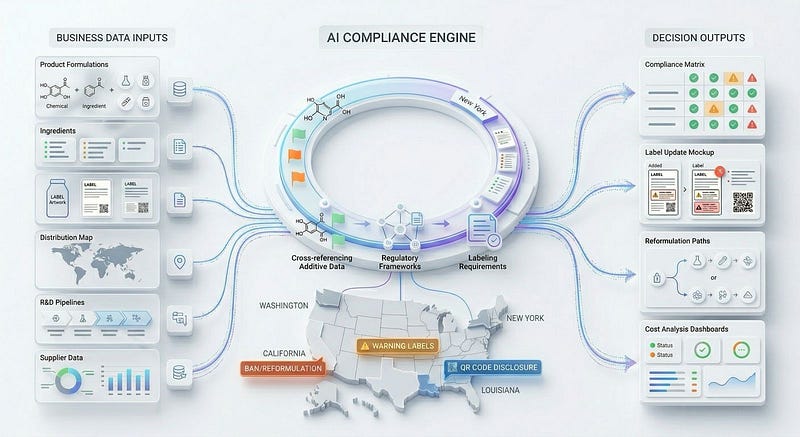
AB 418 Marks the Start of a New Compliance Model
From static standards to continuous, state-specific execution.
Newsletter
New posts, straight to your inbox.
F&B compliance insights, curated from real compliance work. Free, and you can unsubscribe any time.