
/3 min read
Ingredient Permissibility Isn’t a Check - It’s a System
Why F&B teams must move from manual validation to a Compliance Execution Layer


Ingredient Permissibility Pre-Check Isn’t a Step - It’s a Gatekeeper
Before formulation begins, before branding takes shape, before a product enters the pipeline - there’s a fundamental constraint:
Can you even use this ingredient?
For most Food & Beverage teams, the answer isn’t immediate. It’s investigated, debated, and often re-validated multiple times.
The Illusion of Simplicity
“Is this ingredient allowed?” sounds binary.
In reality, it’s conditional.
Across markets, permissibility depends on:
Regulatory lists and positive/negative frameworks
Maximum usage levels tied to product categories
Context-specific conditions (e.g., function, processing method)
Notification or pre-market approval requirements
An ingredient may be allowed in one market, restricted in another, and conditionally permitted depending on usage.
This isn’t a lookup problem. It’s a multi-variable decision system - without a system.
How It’s Done Today (Fragmented by Design)
Most teams rely on a mix of:
Regulatory PDFs and databases (CFIA, FDA, EFSA)
Internal expertise and historical decisions
External consultants for validation
Spreadsheets and email threads to document outcomes
Each validation becomes a mini project.
There is no standardized workflow. No consistent output format. No persistent memory.
So the same questions get asked again:
Was this already approved?
Under what conditions?
For which market?
And often - no one is fully certain.
The Real Risk Isn’t Non-Compliance. It’s Inconsistency.
The issue isn’t just getting it wrong.
It’s getting different answers at different times.
Decisions vary by reviewer
Assumptions aren’t captured
Context gets lost between teams
Re-validation slows everything down
By the time a product reaches labeling or submission, permissibility is no longer a question - it’s a liability.
The Missing Layer: Compliance That Executes
What’s broken isn’t effort. It’s architecture.
Regulations live as text.
Interpretation lives in people.
Outputs live in files.
Nothing connects them into a system that can run.
A new category is emerging to solve this:
Compliance Execution Layer
Instead of treating compliance as research or documentation, this layer:
Converts regulations into structured, machine-readable rules
Standardizes how decisions are made
Produces consistent, repeatable outputs
It doesn’t assist decisions.
It executes them.
What Ingredient Permissibility Pre-Check Becomes
Within a Compliance Execution Layer, permissibility is no longer an investigation.
It’s a workflow.
Input:
Ingredient
Intended use (function, category)
Target markets
Output:
Permissibility status per market
Maximum usage levels
Conditions of use
Required notifications or approvals
This is not a report. It’s a decision artifact - ready to act on.
How It Plays Out in Practice
Ingredient Validation
A new additive is introduced.
Instead of parsing regulations manually:
The system evaluates it across jurisdictions
Flags permitted, restricted, or novel status
Labeling Alignment
Permissibility links directly to:
Required declarations
Usage constraints tied to label claims
Audit Trail
Every output is:
Traceable to source regulation
Structured and version-controlled
Ready for QA review or regulatory audits
No guesswork. No lost context.
Before vs After
Before
Days per validation cycle
Multiple stakeholders and handoffs
Knowledge trapped in documents
Low traceability, high rework
After
Minutes to decision-ready outputs
Standardized across products and teams
Full traceability to source
Reduced risk and faster iteration
Where Mergen AI Launch™ Fits
Mergen AI Launch™ operationalizes the Compliance Execution Layer - turning ingredient permissibility from a manual investigation into a deterministic workflow.
At its core, the “Ingredient Permissibility Pre-Check” runs as a structured system:
1. Ingredient Submission
R&D submits a finalized ingredient list with intended usage levels (mg/kg or % w/w), along with target food category and jurisdictions.
2. Identifier Resolution
Each ingredient is automatically mapped to a canonical substance.
Synonyms, E-numbers, CAS numbers, INS numbers, and regional naming differences are resolved into a single, unambiguous identity within the knowledge graph.
3. Permissibility Execution
The system evaluates each substance against regulatory frameworks:
No manual lookup. No interpretation drift.
4. Matrix Generation
Outputs are structured into a permissibility matrix:
Ingredient × Jurisdiction × Food Category
Including maximum permitted levels where applicable
This creates a clear, comparable view across markets - instantly.
5. RA Flagging & Reformulation Signals
Any restricted or conditional ingredients are flagged automatically.
Regulatory and R&D teams receive clear signals:
Where usage exceeds limits
Where approval conditions apply
Where reformulation is required
What the System Produces
Instead of fragmented notes, Launch™ generates:
A complete permissibility matrix
Maximum permitted levels per substance
Clear conditions of use
Flagged restrictions with actionable alternatives
All outputs are traceable, structured, and audit-ready by default.
From Pre-Check to System Capability
Ingredient permissibility shouldn’t slow down innovation.
It should enable it.
The shift isn’t about doing compliance better.
It’s about making compliance runnable.
Mergen AI is not another layer of tooling.
It’s the infrastructure that turns regulatory complexity into executable decisions - embedded directly into how products get built.
Written by

Nijat Guliyev
Removing Compliance Bottlenecks to Accelerate Food & Beverage Market Entry | Sales Director @ Mergen AI
Keep reading
More from the blog
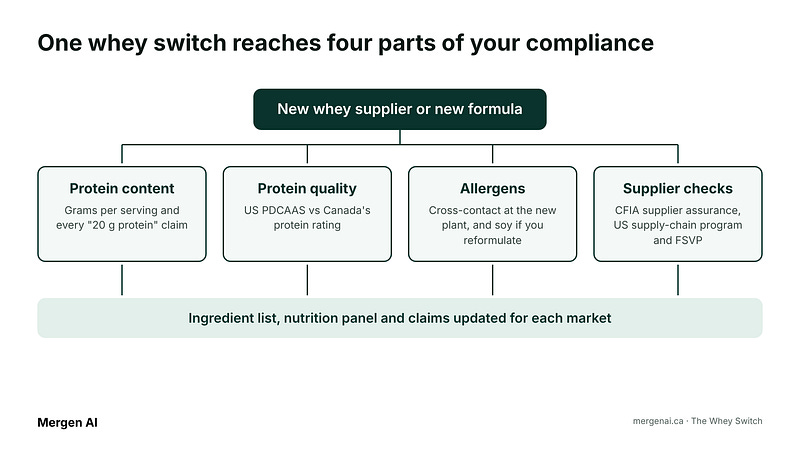
/5 min read
The Whey Switch: How a Dairy Tariff Fight Lands on Your Label
Tariffs and a US whey ban are forcing fast supplier switches. Here’s what that can break on your label.

/6 min read
The Changeover Gap: What the Gatorade Dye Recall Teaches Every Label Team
PepsiCo promised natural colours, then recalled 122,021 cases for undeclared synthetic dyes. What went wrong, and how to avoid it in your own phase-out.
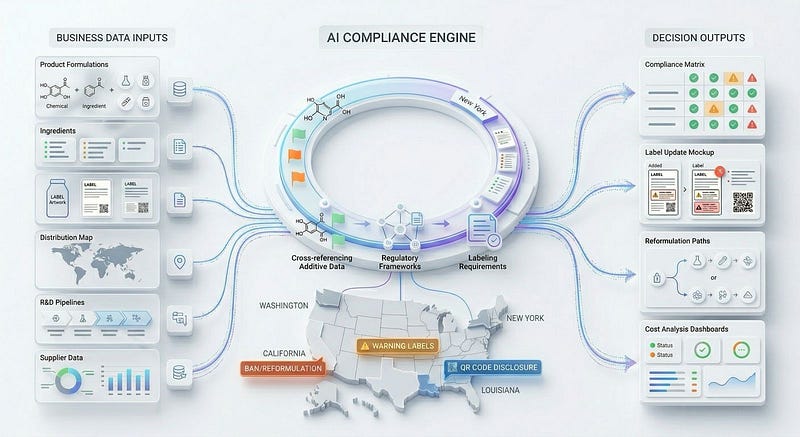
/7 min read
AB 418 Marks the Start of a New Compliance Model
From static standards to continuous, state-specific execution.
Newsletter
New posts, straight to your inbox.
F&B compliance insights, curated from real compliance work. Free, and you can unsubscribe any time.