
/2 min read
CFIA Compliance 101: What Food & Beverage Businesses Need to Get Right from Day One in Canada.
The core CFIA requirements that protect market access and keep food & beverage launches on schedule


If you manufacture, process, package, label, or import food and beverage products for the Canadian market, CFIA compliance isn’t paperwork - it’s the operating system that protects market access, reduces recall risk, and keeps launches on schedule.
Canada’s modern regulatory framework is anchored in the Safe Food for Canadians Act (SFCA) and the Safe Food for Canadians Regulations (SFCR), which are administered and enforced by the Canadian Food Inspection Agency (CFIA). Together, they set expectations across licensing, preventive controls, traceability, and labelling.
Understanding how these pillars work in practice is essential for any growing brand.
1) Licensing: the “entry ticket” for many food & beverage activities
Under SFCR, certain food and beverage businesses require a licence to conduct regulated activities. CFIA manages most licensing through My CFIA, where companies create business profiles and submit licence-related requests. If you import most foods or beverages into Canada, an SFC licence is generally required.
Common pitfall: many teams treat licensing as a one-time administrative task - then scramble when they need export certificates, updates, or proof during an inspection. Building a compliance “home base” early helps avoid last-minute fire drills.
2) Preventive controls: proving risks are identified and managed
SFCR requires many businesses to prepare, keep, and maintain a written Preventive Control Plan (PCP), with some exceptions for certain small businesses. A PCP documents how food safety hazards are identified, controlled, and monitored across operations.
During inspections, CFIA often evaluates not just whether a PCP exists, but whether it reflects real operational controls and records. This is where gaps between documentation and day-to-day execution frequently surface.

3) Traceability: “one step back, one step forward”
SFCR traceability rules require many food and beverage businesses to track products back to the immediate supplier and forward to the immediate customer.
Strong traceability systems can significantly reduce the scope of recalls, speed up investigations, and limit business disruption when issues arise.
4) Labelling: bilingual requirements and allergens are non-negotiable
For most consumer prepackaged foods and beverages, mandatory label information must appear in both English and French. Ingredient lists, allergen declarations, and certain claims are among the most common failure points.
Errors here often trigger rework, product delays, delisting risks with retailers, or border complications for importers.
Where Mergen AI Launch fits:
Mergen AI Launch turns CFIA/SFCR obligations into executed workflows - not scattered files. It centralizes product data, validates bilingual labelling, ingredients and allergens, and assembles inspection-ready documentation with built-in traceability and audit readiness, helping food and beverage teams launch faster with fewer compliance surprises.
Written by

Nijat Guliyev
Removing Compliance Bottlenecks to Accelerate Food & Beverage Market Entry | Sales Director @ Mergen AI
Keep reading
More from the blog
/5 min read
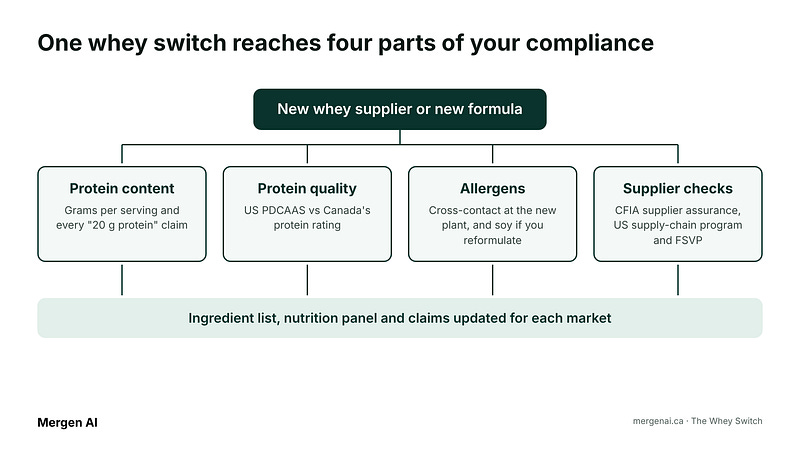
The Whey Switch: How a Dairy Tariff Fight Lands on Your Label
Tariffs and a US whey ban are forcing fast supplier switches. Here’s what that can break on your label.

/6 min read
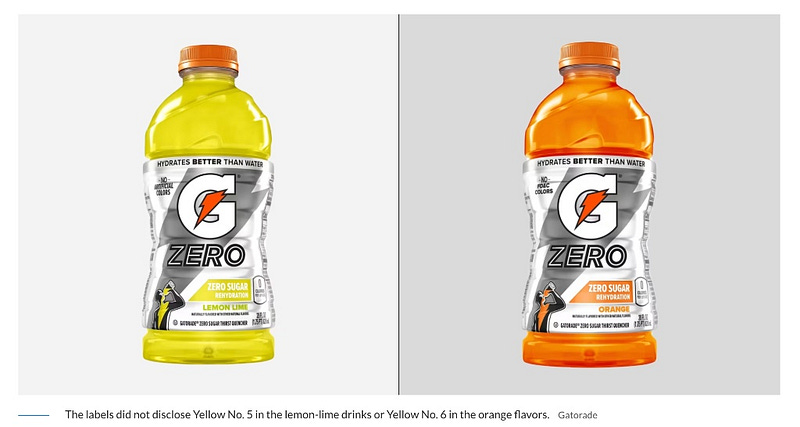
The Changeover Gap: What the Gatorade Dye Recall Teaches Every Label Team
PepsiCo promised natural colours, then recalled 122,021 cases for undeclared synthetic dyes. What went wrong, and how to avoid it in your own phase-out.
/7 min read
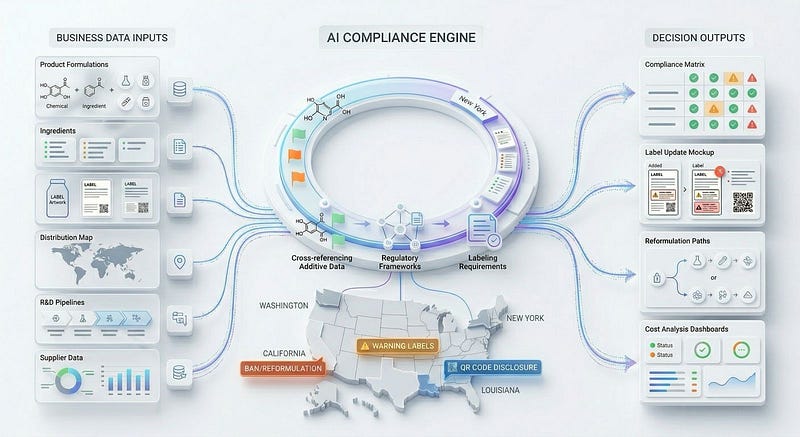
AB 418 Marks the Start of a New Compliance Model
From static standards to continuous, state-specific execution.
Newsletter
New posts, straight to your inbox.
F&B compliance insights, curated from real compliance work. Free, and you can unsubscribe any time.